3 Problems and the Fall
Here is your last task for today. Not now, but when I say “go,” take 1 minute to answer this question with your new friends in front or behind: what is an example of human creating gone wrong? You may want to think of a disaster to answer this question. “Go!”
OK. Thanks for that!
I want to discuss a few ways design and creativity goes wrong and give some examples to illustrate. You can see if you have the same examples as me.
3.1 Dishonesty, sin, and evil
One category of ways human creating can go wrong is dishonesty, sin, and evil; as we Christians would call it, the Fall. A good (or should I say bad) example is the 2015 Volkswagen emissions scandal in which engineers programmed engine emission controls to activate, shall we say, … selectively. The VW Golf met regulatory standards during EPA testing. But during real-world driving, the cars emitted 40-times more nitrous oxides, polluting the air and creating smog.

When dishonesty, sin, and evil take up residence in engineering teams, the results aren’t good. 11 million cars were involved in the falsified emission reports, and the cost to Volkswagen has been $33.3 billion.
3.2 Human finitude
But evil is not the only problem that occurs when humans create. A second cause of problems is human finitude, different from the Fall.
In preparation for one flight of the prototype Venus balloon system in California, my colleague Jonathan and I were both given new roles on the team: he became the modeling lead, and I became the buoyancy system lead. Here is the equation for net force on the balloon system prior to launch.
\[ F_{net} = \rho_{atm} \, V_{displaced} \, g - (m_{dry} + m_{He} + m_{PCF} ) \, g - m_{FL} \, g = 0 \]
Jonathan ran our trajectory model with up-to-date weather data and provided a suggested amount of free lift (\(m_{FL}\)) for the flight. Now, free lift is the amount of additional mass required to achieve neutral buoyancy at the launch site. To launch, the free lift mass is removed, the net force turns positive, and the system ascends.
\[ F_{net} = \rho_{atm} \, V_{displaced} \, g - (m_{dry} + m_{He} + m_{PCF} ) \, g - \cancelto{0}{m_{FL}} \, g > 0 \]
Getting the free lift correct for the atmospheric conditions at launch is essential. Too little free lift and the system would ascend once, turn around, and crash. Too much free lift and the system would fly through the tropopause and burst, thereafter crashing back to earth. As buoyancy system lead, I was to implement on the flight system the free lift proposed by Jonathan by adding weights (\(m_{FL}\)) and adjusting the helium charge
(\(m_{He}\)) until the system was trimmed to neutral buoyancy prior to launch.
Maybe you can see where this is going? Jonathan oversaw the model with which he performed symbolic manipulations in the abstract space. I was responsible for the buoyancy system which lived in the very concrete, tangible space at JPL. We split responsibilities exactly along the lines I’m discussing here! We put an interface between us. What could go wrong?
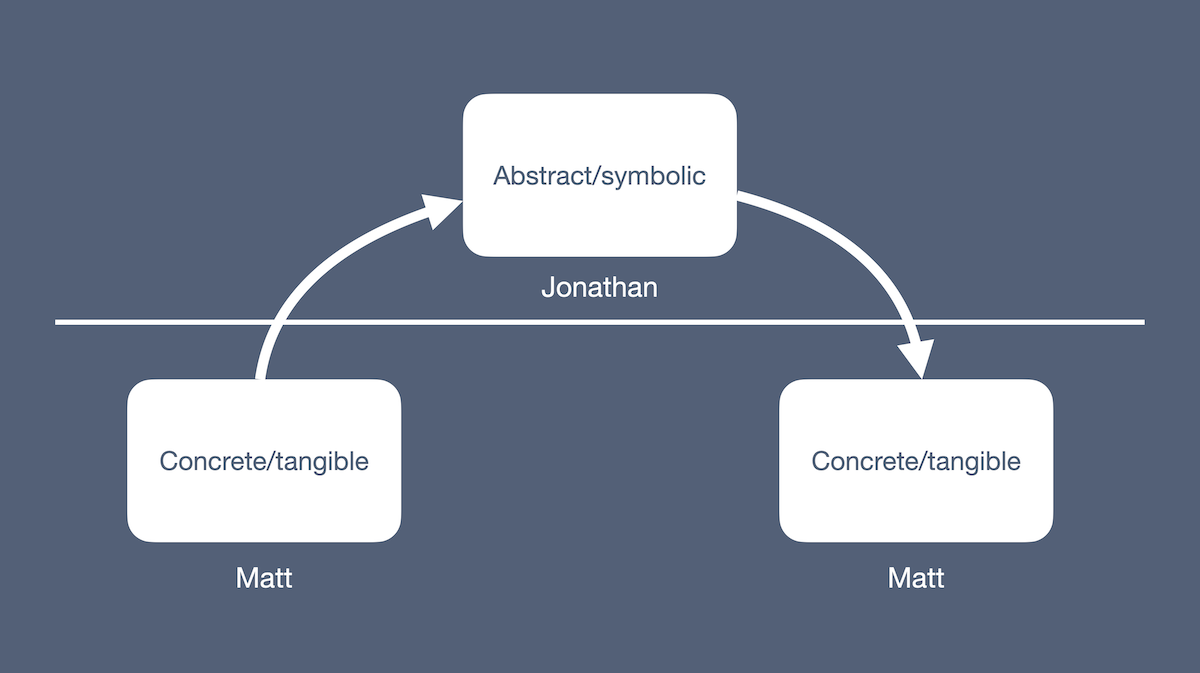
Plenty! We, stupidly in retrospect, communicated in units of kilograms with the precision of tens of grams. We should have been communicating in units of grams with the precision of tenths of grams for an Earth prototype flight. Our scales even measured to a tenth of a gram, but we didn’t use that setting! As a result, we overcooked the free lift by a few grams, with disastrous effects. (Thankfully, the Venusian atmosphere is much more forgiving than the Earth atmosphere, and the required precision is much less.)
We flushed 70 thousand dollars down the toilet that day. It was not my finest hour! But for future (successful) prototype flights, we did it right.
I’ll say it again, the process of moving from the concrete and tangible space to the abstract and symbolic space and back again is fraught. We weren’t evil in our work. I don’t think the balloon’s crash was the result of the Fall. We simply didn’t anticipate the problems that could be caused by our lack of precision. We should have, but we didn’t. Human finitude bit us in the backside.
Some of you know my experience is not the only time NASA threw away money because of unit problems! Mars Climate Orbiter, I’m looking at you and your Newton-to-lbf problem. That price tag was $328 million!
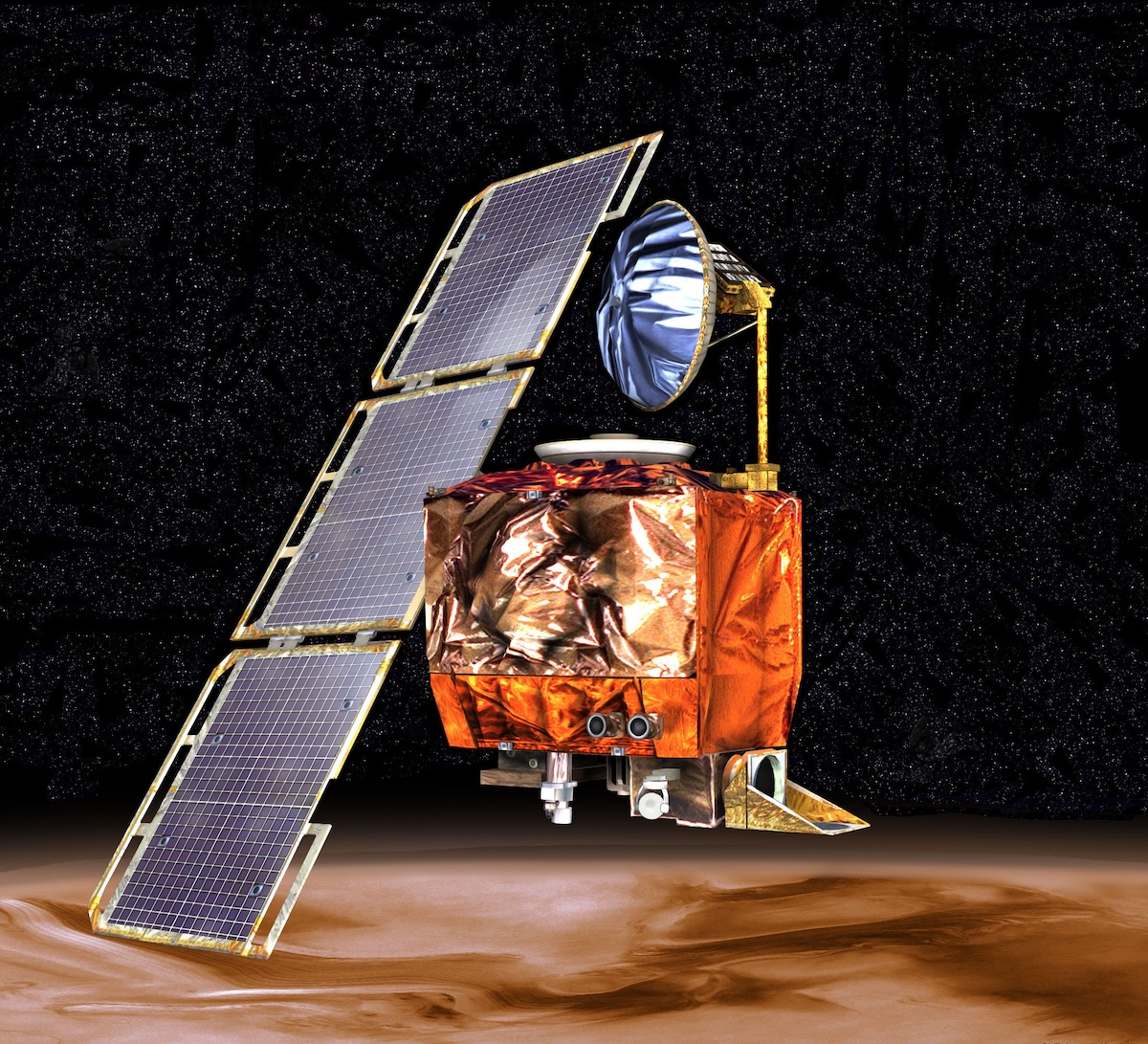
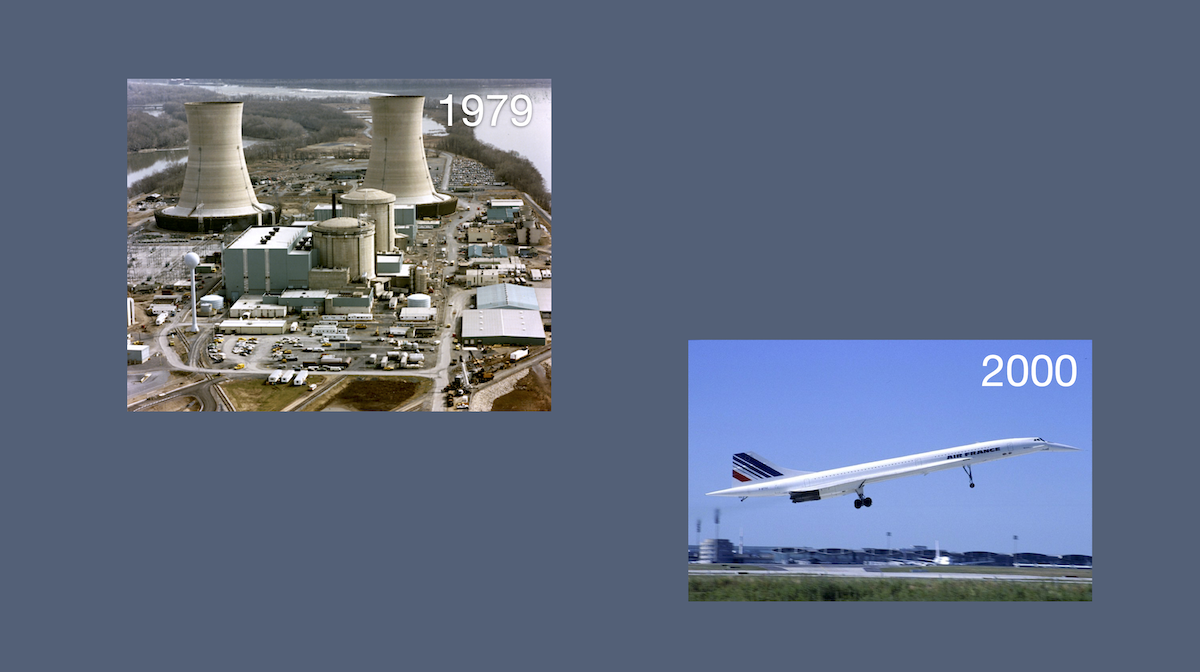
Other disasters to which human finitude was a contributing factor include:
- the near-meltdown at Three Mile Island in which plant operators failed to recognize a loss-of-coolant accident and
- the Air France Flight 4590 crash in which runway debris led to 113 deaths and the end of the Concorde program.


-2.jpg)

Symbolic manipulations performed by designers in the abstract space did not, and arguably could not have ever, anticipated the cascades of events in these disasters.
3.3 The problem of scale
A third way things can go wrong is what I have begun calling the problem of scale, although there is probably a better name. We engineers design technologies to solve problems, often for individuals, at what I’ll call the “micro” level, a term borrowed from economics, covering individuals and firms. Refrigerators keep food and medicines cold for a family. Cars enable people to visit families or get to work.
However, those machines have the following characteristics:
- they require raw material extraction to fabricate,
- they require energy to operate,
- they are a source of carbon dioxide emissions during operation, and
- they are a source of pollution upon disposal.
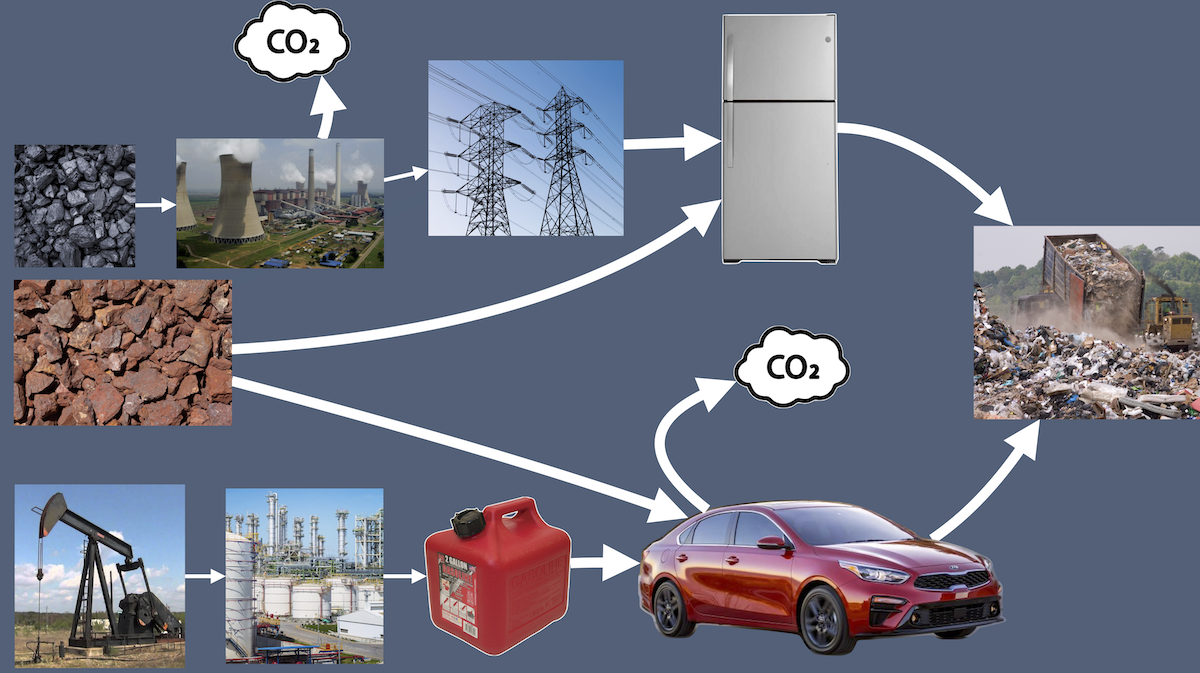
Few technologies by themselves are a problem at a micro scale.
- One car does not appreciably deplete oil reserves or warm the planet.
- One refrigerator does not fill a junkyard.
But what happens at the macro level, meaning nations and the world? When technologies become widespread, when they are deployed at scale, we see new problems emerge. Those problems go by the names “resource depletion” and “environmental damage.”
At the individual level, these technologies are helpful for anyone who can afford them. However, at the macro level, the effects of these technologies are everyone’s problem but nobody’s fault.
Worse, when you think about it, there are myriad incentives and features of the modern world that expand the reach of our designed machines. At the micro level, engineers design for the largest “addressable market,” creating the relentless drive to reduce costs. At the macro level, economic growth can increase wages and enable more people to buy more stuff. Democracy enables people to vote their pocketbooks, increasing pressure on politicians to pursue economic growth above all else. The globalized market economy enables anyone with means to access and use the machines designed by engineers. The concept of justice drives us to ensure that the greatest number of people are given access to machines that consume energy and materials and generate waste.
The impacts of the problem of scale are striking. I’ll give a few examples. This paper by Fridolin Krausmann et al. includes a graph of the exponential growth of mass extracted from the Earth annually since 1900.
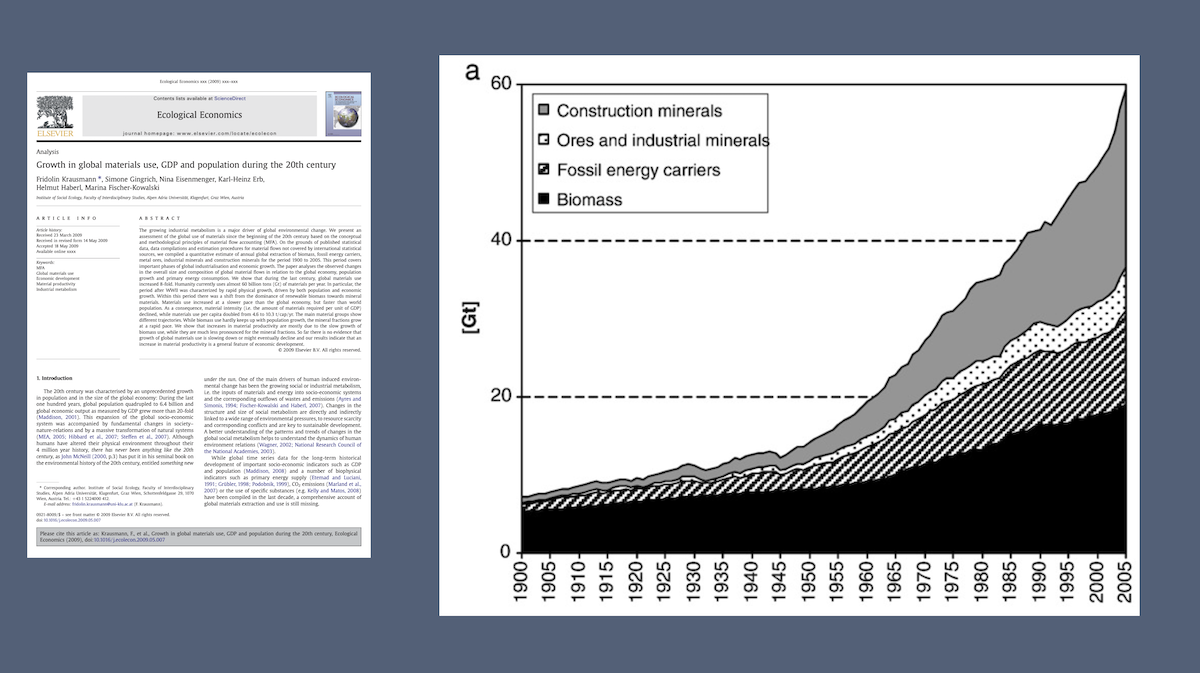
We are really good and getting better at mining and forestry!
Here’s a graph from Jeremy and my book showing the coal extracted from the United Kingdom since the early 1800s. Miners have extracted nearly all the coal from the UK.
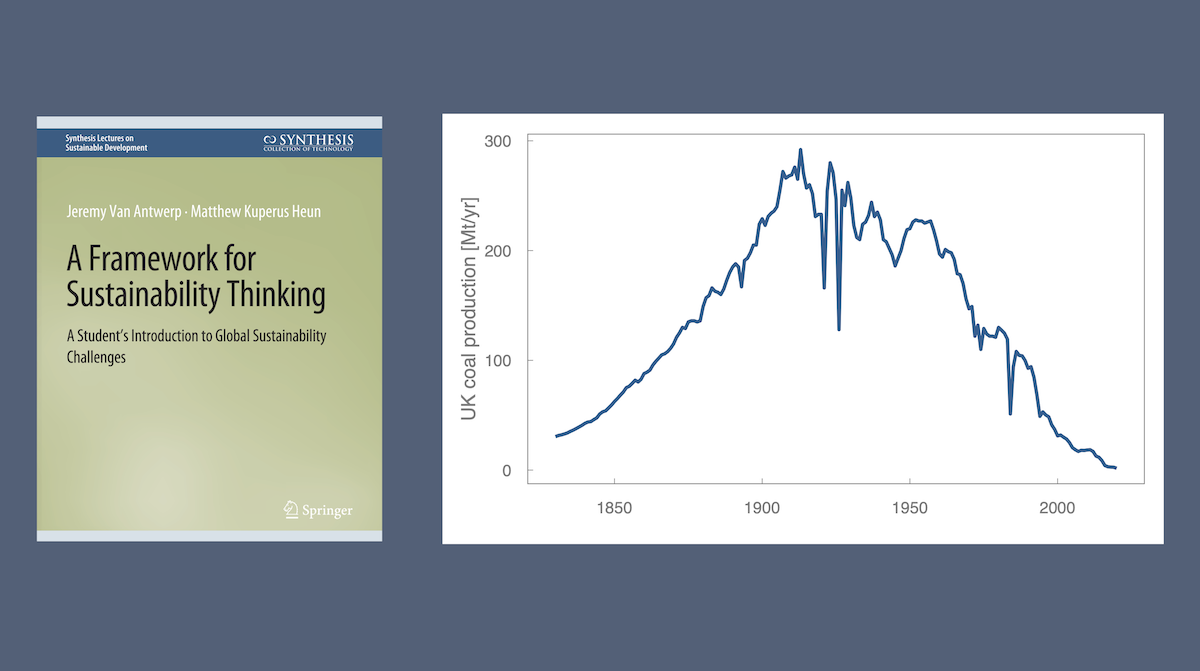
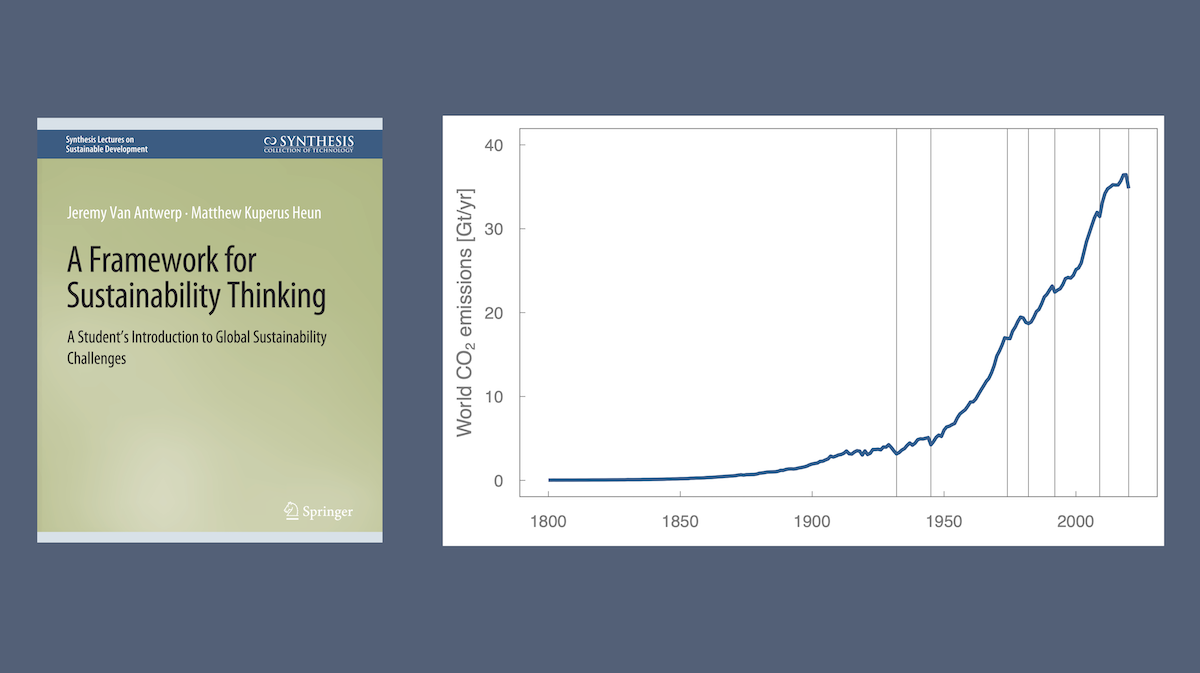
And the result of burning all that coal (and other fossil fuels) is rising CO2 emissions. By the way, the vertical lines on this graph indicate years with recessions. Recessions are seemingly the only evidence-based way to reduce CO2 emissions. It appears that our economies depend on CO2 emissions for success.
A final graph needs a bit of explaining. The horizontal axis is human development index, a unitless, statistical mix of per-capita income, life expectancy, and education. HDI greater than 0.8 is considered “very high human development” by the UN. We want nations to be toward the right. The vertical axis is ecological footprint measured in global hectares per person. A sustainable level of fair use of the planet is 1.9 hectares per person. We want to be below this line. So the lower right corner is the sweet spot. Each country is a point, with population represented by size, and continent represented by color. Here are the data. In the world today, it appears that there is a tradeoff between HDI and ecological footprint. Many countries are living within planetary limits, on average, but their citizens have a difficult life. Other countries are living well but consuming more than their fair share of the planet to do so. None are in the sweet spot.
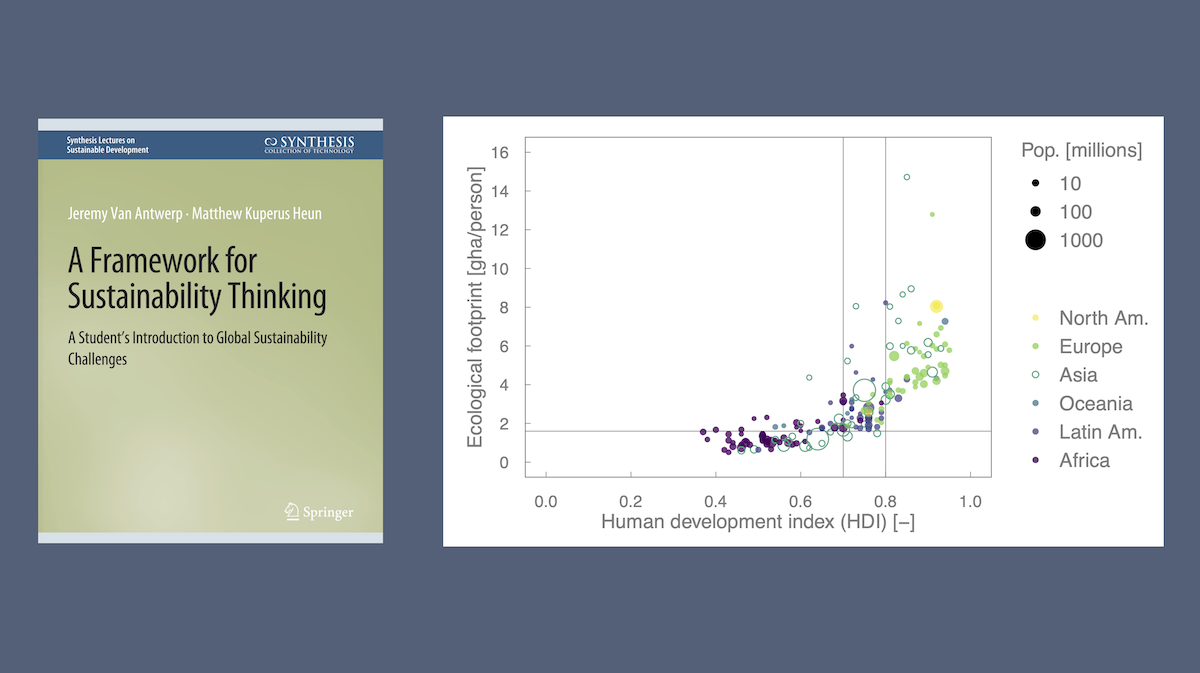
We’re very good at making some people’s lives better at the micro level, and we see it in the data. However, we’re turning the planet inside out to do so. Problems emerge at the macro level that we cannot see at the micro level when we are doing our good work to solve problems for individuals and firms.
We might say that we human beings are dominating the Earth, literally turning the Earth inside out to run our continually growing economies to provide a good life for some people. Furthermore, remember Tai Danae Bradley’s eloquence about the wonders of creation last night? A damaged and diminished creation means there will be fewer “letters to make us ponder the invisible things of God” and “convict humans,” leaving us “without excuse.”
Two passages from Genesis and other contextual evidence illustrate that we are called to do otherwise. First, Genesis 1:28 (the so-called “cultural mandate” verse) indicates that one aspect of the way humans are meant to relate to the non-human portions of creation is dominion. “Be fruitful and increase in number; fill the earth and subdue it. Rule over the fish in the sea and the birds in the sky and over every living creature that moves on the ground.”
If you’re enamored with the cultural mandate, I hope I don’t problematize it too much for you just now. But the key verbs “subdue” and “rule” are usually poorly understood. Steven Bouma Prediger’s chapter in Beyond Stewardship brings out a more faithful understanding. He says,
A larger canonical perspective sheds light on this. … Psalm 72 speaks clearly of the ideal [ruler or] king: one who rules and exercises dominion properly. … Such a ruler executes justice for the oppressed, delivers the needy, helps the poor, and embodies righteousness in all things. In short, the proper exercise of dominion yields shalom: the flourishing of all the creation. This is a far cry from dominion as domination. And Jesus, in the Gospel accounts, defines dominion in terms clearly contrary to the way it is often understood. For Jesus, the ideal king, to rule is not to subdue but to serve. To exercise dominion is to suffer, if necessary, for the good of the other. Domination, exploitation, or misuse is unacceptable. We humans are called to rule, but ruling must be understood rightly.
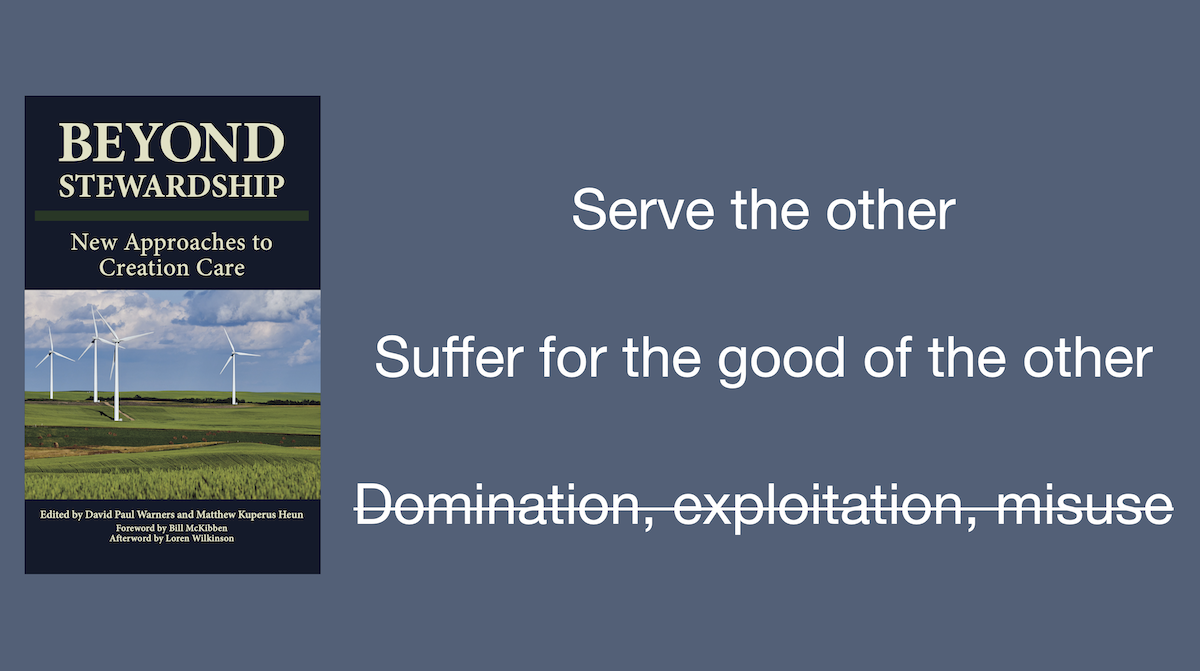
Second, Genesis 2:15 further develops the theme of service. “The Lord God took the man and put him in the Garden of Eden to work it (abad) and take care of it (shamar).” Different and better translations of abad and shamar are “serve” and “protect” or “keep.” Here, “keep” is the Aaronic blessing, “The Lord bless you and keep you; the Lord make his face to shine upon you and be gracious unto you; the Lord lift his countenance upon you and give you peace.” I submit that this type of keeping is inconsistent with “turn you inside out.” So we humans are meant to rule over the Earth, sure. But we are not called to dominate; rather, we are called to be the ideal ruler, one who serves, sacrifices for, and protects the non-human parts of creation. Seen in this context, the problem of scale is a huge problem, one that drives at the heart of what it means to be human and how we human beings should relate to the nonhuman parts of creation.
Engineering: What are we doing?
We design things that solve problems on the micro level but cause problems at the macro level, at scale. That’s something to lament.